MBBS in China Fee Structure 2026-2027: Complete Cost Breakdown for Pakistani Students
January 23, 2026 | by baharedu.com
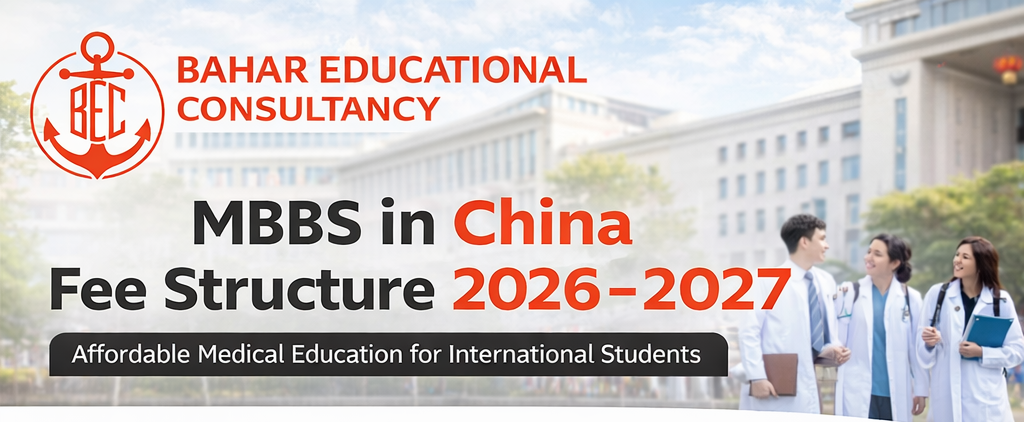
Studying MBBS in China has become increasingly popular among Pakistani students seeking quality medical education at affordable costs. With over 45 WHO-recognized medical universities and PMC-approved programs, China offers excellent value for aspiring doctors. This comprehensive guide breaks down the complete fee structure for MBBS in China for the 2026-2027 academic session. MBBS in China Fee Structure 2026-2027
Understanding MBBS in China Fee Structure 2026-2027
The cost of pursuing MBBS in China varies significantly based on several factors including the medium of instruction, university ranking, location, and facilities provided. Chinese medical universities offer two main program types that directly impact the overall cost.
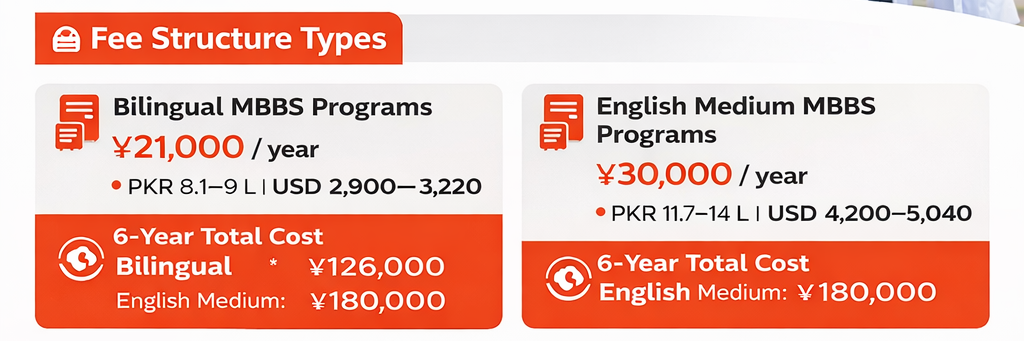
Bilingual MBBS Programs
Bilingual programs combine Chinese and English instruction, offering students an opportunity to learn the local language while studying medicine. These programs are generally more economical and provide better integration into Chinese medical practice.
Annual tuition fee: Approximately ¥16,000 to ¥23,000 (PKR 6.24 lakhs to 8.97 lakhs or USD 2,240 to 3,220)
Total 6-year program cost: Around ¥96,000 to ¥138,000 (PKR 37.44 lakhs to 53.82 lakhs or USD 13,440 to 19,320)
English-Medium MBBS Programs
English-medium programs are specifically designed for international students, with all lectures, examinations, and clinical training conducted entirely in English. These programs attract the majority of Pakistani students due to language convenience.
Annual tuition fee: Approximately ¥21,000 to ¥36,000 (PKR 8.19 lakhs to 14.04 lakhs or USD 2,940 to 5,040)
Total 6-year program cost: Around ¥126,000 to ¥216,000 (PKR 49.14 lakhs to 84.24 lakhs or USD 17,640 to 30,240)
Detailed Cost Components of MBBS in China Fee Structure 2026-2027
Understanding each component of the fee structure helps students plan their finances more effectively. Here’s a detailed breakdown of all expenses associated with studying MBBS in China.
One-Time Fees (First Year Only)
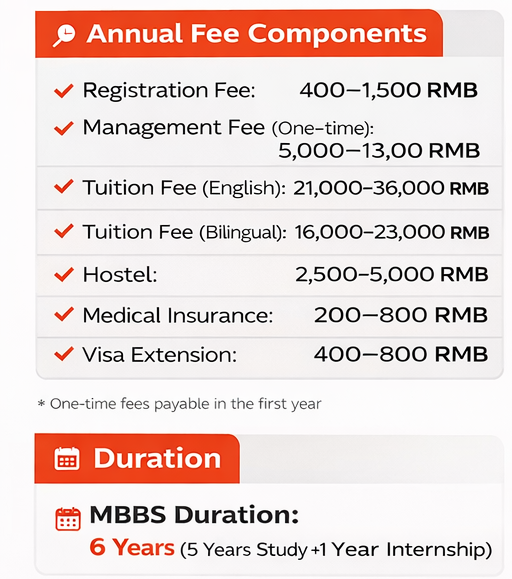
Registration Fee: ¥400 to ¥1,500 (PKR 15,600 to 58,500 or USD 56 to 210)
This initial fee covers the application processing and admission formalities. Most universities charge this fee upon acceptance of admission.
Management Fee: ¥5,000 to ¥13,000 (PKR 195,000 to 507,000 or USD 700 to 1,820)
The management fee is a one-time charge that covers administrative services, student support, library access, laboratory facilities, and other university resources throughout your study period.
Annual Recurring Fees
Tuition Fee (English Medium): ¥21,000 to ¥36,000 per year (PKR 8.19 lakhs to 14.04 lakhs or USD 2,940 to 5,040)
Tuition Fee (Bilingual Medium): ¥16,000 to ¥23,000 per year (PKR 6.24 lakhs to 8.97 lakhs or USD 2,240 to 3,220)
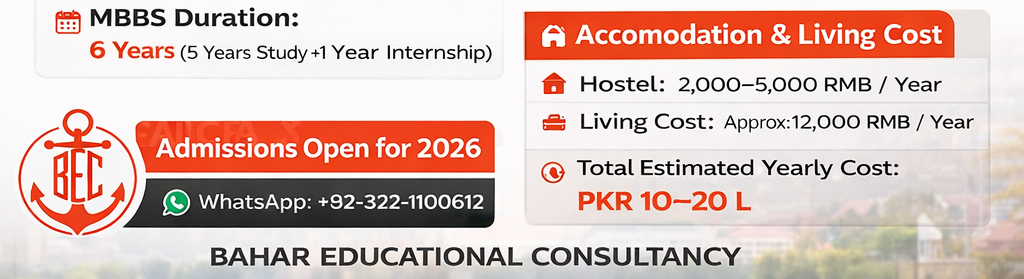
Hostel/Accommodation: ¥2,500 to ¥5,000 per year (PKR 97,500 to 195,000 or USD 350 to 700)
Accommodation costs vary based on room type. Shared dormitories typically cost around ¥2,500 per year, while private or double-occupancy rooms range from ¥4,000 to ¥5,000 annually.
Medical Insurance: ¥200 to ¥800 per year (PKR 7,800 to 31,200 or USD 28 to 112)
Comprehensive medical insurance is mandatory for all international students studying in China and covers basic healthcare needs.
Visa Extension Fee: ¥400 to ¥800 per year (PKR 15,600 to 31,200 or USD 56 to 112)
International students must renew their student visa annually, which involves a processing fee paid to Chinese immigration authorities.
Top Universities for MBBS in China with Fee Structure 2026-2027
Selecting the right university is crucial for your medical career. Here’s a detailed look at some popular Chinese medical universities among Pakistani students, along with their annual fee structure.
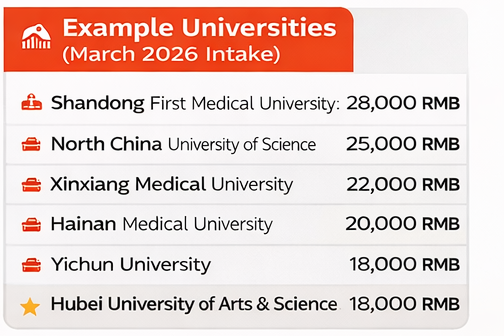
Shandong First Medical University
Annual Tuition: ¥28,000 (approximately PKR 10.92 lakhs or USD 3,920)
Located in Jinan, Shandong province, this university is recognized by WHO and PMC, offering excellent clinical training facilities and modern infrastructure.
North China University of Science and Technology
Annual Tuition: ¥25,000 (approximately PKR 9.75 lakhs or USD 3,500)
Situated in Tangshan, Hebei province, this university provides quality medical education with well-equipped hospitals and experienced faculty.
Xinxiang Medical University
Annual Tuition: ¥22,000 (approximately PKR 8.58 lakhs or USD 3,080)
This university in Henan province offers affordable medical education with good clinical exposure and modern teaching methods.
Hainan Medical University
Annual Tuition: ¥20,000 (approximately PKR 7.8 lakhs or USD 2,800)
Located in the tropical island province of Hainan, this university provides a unique learning environment with excellent weather and beautiful surroundings.
Yichun University
Annual Tuition: ¥18,000 (approximately PKR 7.02 lakhs or USD 2,520)
One of the most affordable options for MBBS in China, Yichun University in Jiangxi province offers quality education at budget-friendly rates.
Hubei University of Arts and Science
Annual Tuition: ¥18,000 (approximately PKR 7.02 lakhs or USD 2,520)
This university combines medical education with a comprehensive academic environment, providing students with diverse learning opportunities.
Additional Living Expenses for Pakistani Students
Beyond tuition and accommodation, students need to budget for daily living expenses. These costs can vary significantly based on lifestyle choices and the city where you study.
Monthly Food and Dining Costs
Campus Cafeteria: ¥800 to ¥1,200 per month (PKR 31,200 to 46,800 or USD 112 to 168)
University cafeterias offer affordable meal options with various cuisines including halal food options for Muslim students.
Outside Dining: ¥1,500 to ¥2,500 per month (PKR 58,500 to 97,500 or USD 210 to 350)
Dining at local restaurants or cooking your own meals typically costs more but offers greater variety and flexibility.
Transportation Costs
Monthly Public Transport: ¥100 to ¥300 (PKR 3,900 to 11,700 or USD 14 to 42)
Chinese cities have excellent public transportation systems including buses, metros, and shared bikes that are affordable for students.
Personal Expenses and Miscellaneous
Books and Study Materials: ¥1,000 to ¥2,000 per year (PKR 39,000 to 78,000 or USD 140 to 280)
Mobile and Internet: ¥100 to ¥200 per month (PKR 3,900 to 7,800 or USD 14 to 28)
Clothing and Personal Items: ¥2,000 to ¥4,000 per year (PKR 78,000 to 156,000 or USD 280 to 560)
Total Annual Budget for MBBS in China
Calculating the complete yearly budget helps students and parents plan finances effectively. Here’s a comprehensive breakdown.
Budget Category One: Economy Option
Tuition (Bilingual/Affordable University): ¥18,000 (PKR 7.02 lakhs)
Hostel (Shared Room): ¥2,500 (PKR 97,500)
Food (Campus Cafeteria): ¥10,800 (PKR 421,200)
Insurance and Visa: ¥1,000 (PKR 39,000)
Miscellaneous: ¥3,000 (PKR 117,000)
Total Annual Cost: ¥35,300 (approximately PKR 13.77 lakhs or USD 4,942)
Budget Category Two: Standard Option
Tuition (English Medium): ¥28,000 (PKR 10.92 lakhs)
Hostel (Double Room): ¥4,000 (PKR 156,000)
Food (Mixed): ¥15,000 (PKR 585,000)
Insurance and Visa: ¥1,200 (PKR 46,800)
Miscellaneous: ¥5,000 (PKR 195,000)
Total Annual Cost: ¥53,200 (approximately PKR 20.75 lakhs or USD 7,448)
Budget Category Three: Premium Option
Tuition (Top University): ¥36,000 (PKR 14.04 lakhs)
Hostel (Private Room): ¥5,000 (PKR 195,000)
Food (Dining Out): ¥24,000 (PKR 936,000)
Insurance and Visa: ¥1,500 (PKR 58,500)
Miscellaneous: ¥8,000 (PKR 312,000)
Total Annual Cost: ¥74,500 (approximately PKR 29.06 lakhs or USD 10,430)
Complete 6-Year MBBS Program Cost
The MBBS program in China spans six years including internship. Here’s what you can expect to invest for the complete degree.
Economy Package Total Cost
First year (including one-time fees): ¥40,300 to ¥48,300
Years 2-6 (annual): ¥35,300 × 5 = ¥176,500
Complete program: ¥216,800 to ¥224,800 (PKR 84.55 lakhs to 87.67 lakhs or USD 30,352 to 31,472)
Standard Package Total Cost
First year (including one-time fees): ¥58,200 to ¥66,200
Years 2-6 (annual): ¥53,200 × 5 = ¥266,000
Complete program: ¥324,200 to ¥332,200 (PKR 126.44 lakhs to 129.56 lakhs or USD 45,388 to 46,508)
Premium Package Total Cost
First year (including one-time fees): ¥79,500 to ¥87,500
Years 2-6 (annual): ¥74,500 × 5 = ¥372,500
Complete program: ¥452,000 to ¥460,000 (PKR 176.28 lakhs to 179.40 lakhs or USD 63,280 to 64,400)
Scholarship Opportunities for Pakistani Students
Many Chinese universities offer scholarships that can significantly reduce the financial burden of studying MBBS in China.
Chinese Government Scholarship (CSC)
This prestigious scholarship covers full tuition, accommodation, and provides a monthly stipend of approximately ¥3,000. Competition is intense, but successful candidates enjoy a completely funded medical education.
Provincial Government Scholarships
Various Chinese provinces offer scholarships ranging from 30% to 100% tuition fee waiver for outstanding international students.
University-Specific Scholarships
Individual universities provide merit-based scholarships that can cover 25% to 75% of tuition fees based on academic performance and entrance examination scores.
Payment Methods and Financial Planning
Understanding payment procedures helps ensure smooth financial transactions throughout your study period.
Tuition Payment Schedule
Most Chinese universities require annual tuition payment before the start of each academic year. Some universities accept semester-wise payments with prior arrangement.
Accepted Payment Methods
Bank wire transfer remains the most common method for international fee payment. Students can also use international money transfer services like Western Union, although bank transfers typically offer better exchange rates.
Currency Exchange Considerations
Exchange rates between Pakistani Rupee and Chinese Yuan fluctuate. Students should monitor rates and consider purchasing Yuan when rates are favorable to minimize costs.
Comparison: MBBS in China vs Pakistan
Understanding the cost difference helps students make informed decisions about studying abroad.
MBBS Cost in Pakistan
Private medical colleges in Pakistan charge PKR 20 lakhs to 50 lakhs for the complete 5-year MBBS program, while government medical colleges are significantly cheaper but extremely competitive with limited seats.
MBBS Cost in China
The complete 6-year MBBS program in China costs PKR 84 lakhs to 180 lakhs depending on university choice and lifestyle, offering globally recognized degrees with clinical exposure.
Value Proposition
China offers international exposure, globally recognized degrees, affordable costs compared to Western countries, and opportunities to learn Chinese language and culture, making it an attractive option despite slightly higher costs than Pakistani government colleges.
Tips for Managing Expenses While Studying in China
Smart financial management ensures students can complete their education without unnecessary financial stress.
Budgeting Strategies
Create a monthly budget tracking all expenses, set aside emergency funds equivalent to 2-3 months of living expenses, and use budgeting apps to monitor spending patterns.
Cost-Saving Tips
Cook meals at home instead of dining out frequently, use student discounts for transportation and entertainment, share accommodation to reduce hostel costs, and buy second-hand textbooks from senior students.
Part-Time Work Regulations
International students on student visas are generally not permitted to work in China. However, some universities allow on-campus work opportunities with special permission, typically limited to 10-15 hours per week.
Admission Requirements and Associated Costs
Beyond the main fee structure, admission involves several preparatory costs that students should budget for.
Document Preparation Costs
Passport: PKR 15,000 to 20,000
Educational certificates notarization: PKR 5,000 to 10,000
Medical examination: PKR 8,000 to 15,000
Police clearance certificate: PKR 2,000 to 5,000
Pre-Departure Expenses
Visa application fee: USD 140 to 200 (PKR 39,000 to 56,000)
Air ticket (Karachi/Lahore to China): USD 400 to 800 (PKR 112,000 to 224,000)
Initial settlement money: USD 500 to 1,000 (PKR 140,000 to 280,000)
Understanding the Chinese Academic System
The six-year MBBS program in China follows a structured curriculum designed to produce competent medical professionals.
Program Structure
Years 1-2: Basic medical sciences including anatomy, physiology, biochemistry, and Chinese language courses
Years 3-4: Clinical medical sciences including pathology, pharmacology, microbiology, and introduction to clinical medicine
Year 5: Clinical rotations in various hospital departments with hands-on patient care experience
Year 6: Internship in teaching hospitals with specialized rotations and preparation for licensing examinations
Recognition and Career Prospects MBBS in China Fee Structure 2026-2027
Understanding the global recognition of Chinese medical degrees is essential for career planning.
International Recognition
Chinese medical universities recognized by WHO appear in the World Directory of Medical Schools. Graduates can appear for licensing examinations in Pakistan (PMDC/NEB), USA (USMLE), UK (PLAB), India (FMGE), and many other countries.
Career Opportunities After MBBS from China
Graduates can practice medicine in Pakistan after clearing the National Examination Board (NEB) exam, pursue postgraduate studies (MD/MS) in China or other countries, work with international healthcare organizations, or specialize through residency programs worldwide.
Conclusion
Pursuing MBBS in China offers Pakistani students an excellent opportunity to receive quality medical education at reasonable costs compared to Western countries. With annual expenses ranging from PKR 13.77 lakhs to 29.06 lakhs depending on lifestyle choices and university selection, students can complete their six-year MBBS program within a budget of PKR 84 lakhs to 180 lakhs.
The key to successful financial planning lies in understanding all cost components, choosing the right university based on your budget, applying for available scholarships, and managing expenses wisely throughout your study period. Chinese medical degrees are globally recognized, opening doors to medical practice and further specialization opportunities worldwide.
For Pakistani students aspiring to become doctors, China presents a balanced combination of quality education, international exposure, cultural diversity, and affordability, making it an increasingly popular destination for medical studies in 2026-2027. MBBS in China Fee Structure 2026-2027
Frequently Asked Questions
What is the average cost of MBBS in China for Pakistani students?
The average annual cost ranges from PKR 13.77 lakhs to 20.75 lakhs including tuition, accommodation, and living expenses, making the complete 6-year program cost between PKR 84 lakhs to 129 lakhs.
Are there scholarships available for Pakistani students studying MBBS in China?
Yes, Pakistani students can apply for Chinese Government Scholarships (CSC), provincial government scholarships, and university-specific merit scholarships that can cover 25% to 100% of tuition fees.
Is MBBS from China recognized in Pakistan?
Yes, MBBS degrees from WHO-recognized and PMC-approved Chinese universities are recognized in Pakistan. Graduates must clear the National Examination Board (NEB) exam to practice medicine in Pakistan.
What is the difference between English medium and bilingual MBBS programs in China?
English medium programs conduct all lectures and exams in English with annual fees of ¥21,000 to ¥36,000, while bilingual programs use both Chinese and English with lower fees of ¥16,000 to ¥23,000 per year.
What are the living expenses for students in China?
Monthly living expenses including food, transportation, and personal items range from ¥1,500 to ¥3,500 (PKR 58,500 to 136,500) depending on the city and lifestyle choices. MBBS in China Fee Structure 2026-2027
RELATED POSTS
View all


MBBS in China for Pakistani Students (2025–2026): Comprehensive Guide
April 15, 2025 | by baharedu.com
Study MBBS in China for Pakistani Students – 2025 Guide by Bahar Educational Consultancy
April 12, 2025 | by baharedu.com

Urgent Admission: Last Chance for a 6-Month Language Scholarship
February 1, 2024 | by baharedu.com